


SCR's or silicon controlled rectifiers are switching devices for electrical power consisting of thyristors and a control circuit. Since there are no moving parts, this device can switch electrical loads within milliseconds and for millions of times. The increased speed allows for choosing between zero cross switching (also called zero-cross firing, burst firing or fast cycling) or phase angle switching. Read our FAQ for more information or .
Heater life will be greatly increased by minimizing heater temperature fluctuations because of the less contraction and expansion of the heating elements. Electromechanical relays normally switch power every 10-20 sec. Shorter power switching cycles will reduce the life span. for further questions.
SCR's are recommended:
Based on application (constant, variable or inductive resistance loads) different type of power controller are used:
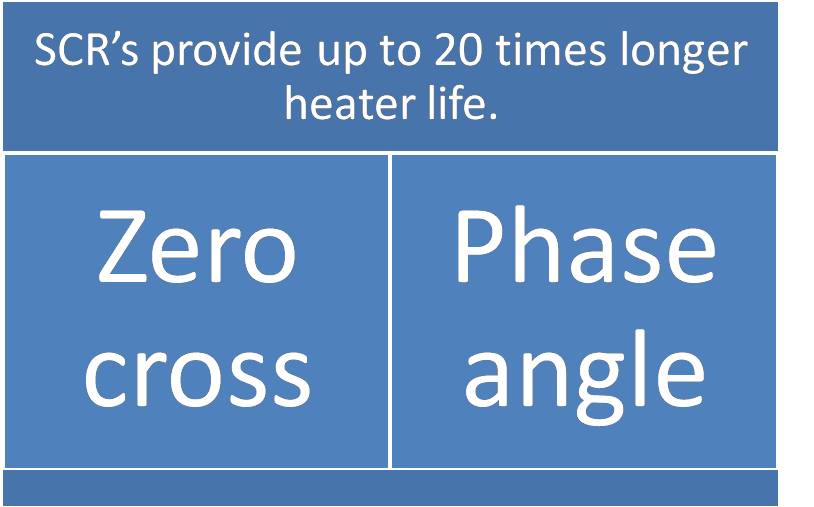
The zero-cross (also called fast cycling or burst firing) is derived from the fact that the SCR's are turned on only when the instantaneous value of the sinusoidal wave is zero. The zero-cross SCR allows power switching in less than 1 sec (every half cycle). This zero-cross SCR will improve heater life significantly for a relative small investment. They are widely used for high temperature and high Watt density heaters, hot air applications (if Nichrome wires are used like in a convection oven or for comfort heating), but not for infrared heating applications. To have an even smoother control, choose a phase angle SCR. Contact us for any question.
In phase-angle control, each SCR of the back-to-back pair (in AC) is turned on for a variable portion of the half-cycle that it conducts. Power is regulated by advancing or delaying the point at which the SCR is turned on within each half cycle. This phase-angle control switches power in milliseconds within the phase and therefore eliminating temperature excursions. Radiant heaters like quartz tubes and T3 lamp or solar energy are typical applications fields. (These applications have a very high hot to cold resistance ratio (for example Tungsten 1:14) so a current control to handle the high in-rush current is mandatory) SCR's can have features such as soft start, shortened SCR detection, Synch-Guard, Trans-Guard. Contact us for any question.
(See our FAQ for more information about SCR power controllers)
Since the development of silicone controlled rectifier power controls in the late 1950's, the power handling capabilities of SCR's (silicon controlled rectifiers) have advanced from a few hundred watts to many megawatts.
As a result, the use of SCR power controllers in industrial heating applications has increased dramatically and they are now used in almost every major industry.
SCR power controllers provide a relatively economical means of power control. SCR power controllers cost less and are more efficient than saturable core reactors and variable transformers. Compared to contactors, SCR power controllers offer a much finer degree of control and do not suffer from the maintenance problems of mechanical devices.
Please contact us with any questions.

|