


General description
Thermistors are temperature sensitive resistors. As all resistors, the resistivity varies with temperature, but thermistors are constructed of semiconductor material which is especially sensitive to temperature. Unlike most other resistive devices, the resistance of a thermistor decreases with increasing temperature. Of the three major contact measuring sensors (thermocouple, RTD, thermistor) they have by far the biggest parameter change with temperature which results in great sensitivity. They have small voltage outputs; not the millivolt outputs thermocouple have. Most thermistor have a negative temperature coefficient.
They’re usually not used for high temperatures (typically up to 200 °F) and only for very limited temperature ranges. Thermistors are one of the most accurate types of temperature sensors. They are more accurate than thermocouples and RTD’s. The disadvantage is the loss of linearity which in turn means that manufacturers have not standardized Thermistor curves to the extent that RTD’s and thermocouple curves have been standardized.
Thermistors are commonly used as temperatures switches; if produced in high volume the cost per sensor can be a couple cents.
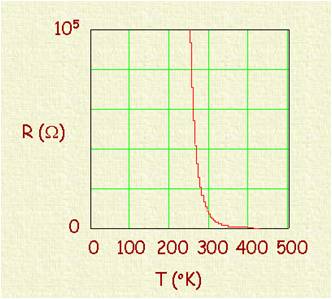
Notice the sharp resistance drop from 100kΩ to a very small value in a range around room temperature.
|